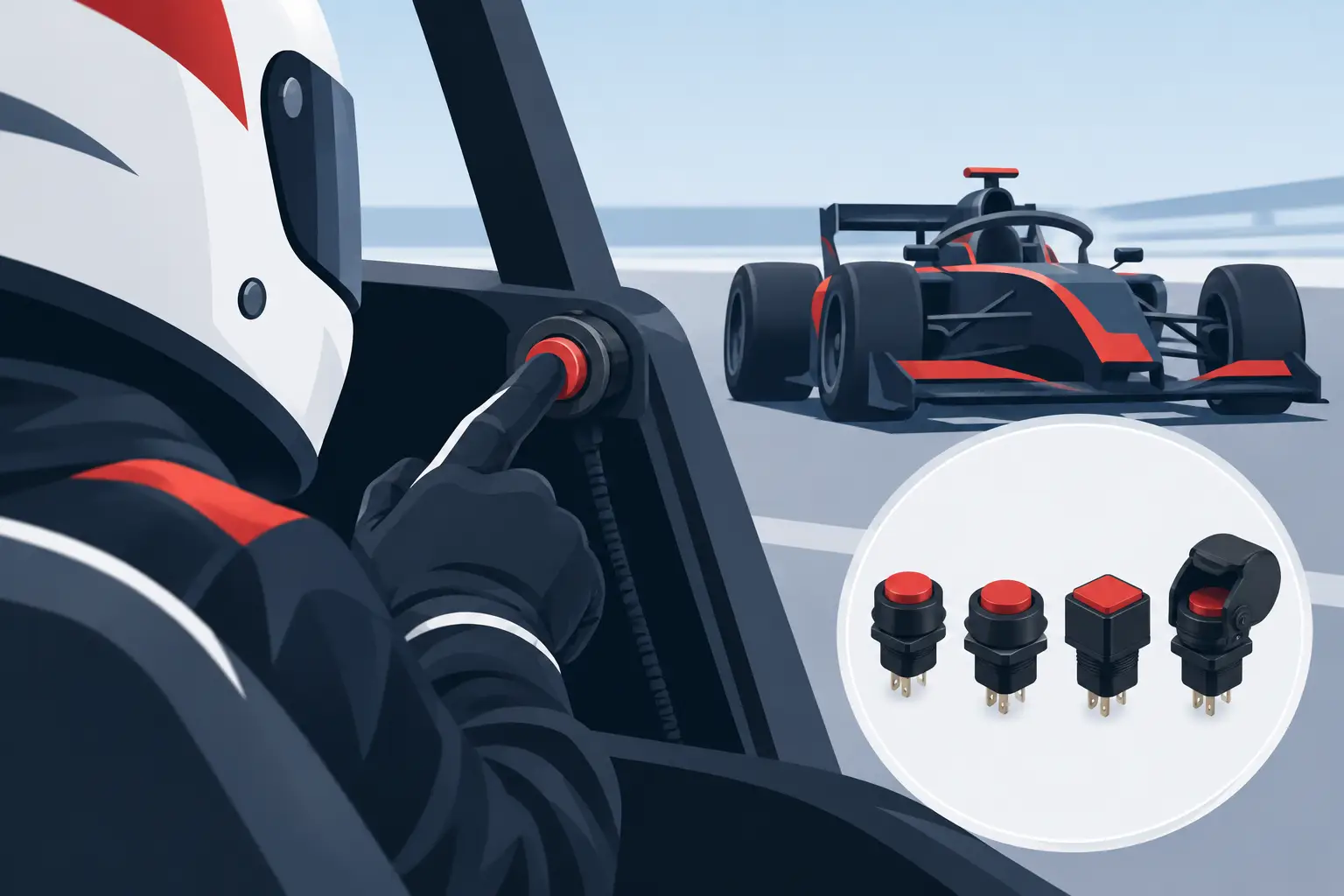
A replacement helmet lead can look like a simple purchase until it reaches the circuit and will not mate with the car loom. The question of which headset connector you need is not answered by the plug shape alone. In motorsport communications, connector series, pin count, gender, wiring arrangement and the equipment brand all matter.
A correct connector choice keeps driver-to-pit audio clear, preserves push-to-talk operation and avoids modifying expensive helmet or radio equipment unnecessarily. A wrong choice can leave a driver without comms, create a poor microphone signal or simply prevent the components from connecting at all.
Which headset connector matches your system?
Start with the complete signal path, not the headset in isolation. Identify the radio or intercom, the vehicle interface or wiring harness, the helmet kit, the push-to-talk switch and any extension lead already fitted. The connector required at one end of a lead may be completely different from the connector required at the other.
For example, a driver may have a LEMO connection at the helmet, a different multi-pin connector at the car bulkhead and a dedicated radio interface behind the dash. Replacing the helmet-to-car lead with a cable that has the right-looking LEMO plug but the wrong pin configuration will not resolve the issue.
Where possible, use the manufacturer and model reference from the existing equipment. Racecom, Speedcom, Autotel, MRTC and Rugged Radios systems can use different connector formats or different wiring conventions within their ranges. Do not assume that two systems are compatible because both are marketed as motorsport radios or because their connectors physically couple together.
Check the connector series first
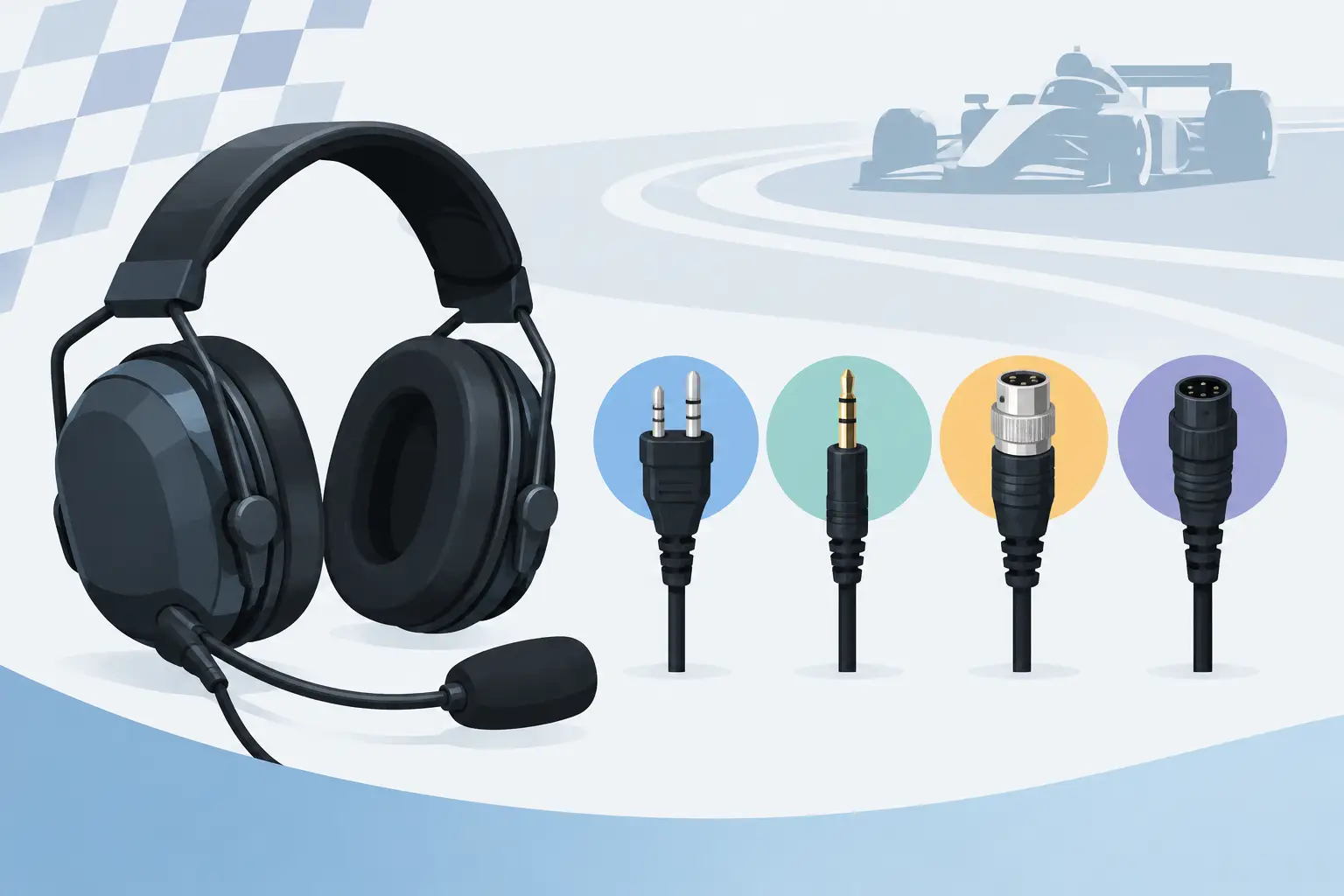
LEMO connectors are widely used in professional motorsport installations because they are compact, secure and suited to repeated use in demanding environments. Their push-pull locking mechanism is particularly useful around helmets, cockpit panels and quick-disconnect driver connections. However, LEMO is a connector manufacturer, not a single universal wiring standard. Different LEMO series, shell sizes and pin arrangements exist.
Nexus-style connectors are also common across racing communications, particularly in helmet, headset and intercom applications. They are often seen on equipment with established professional audio or motorsport heritage. Again, the presence of a Nexus-style plug does not confirm the wiring arrangement, microphone type or equipment compatibility.
Other systems may use circular multi-pin connectors, modular plugs, proprietary radio accessories sockets or moulded helmet connectors. A consumer 3.5 mm jack is not an appropriate substitute for a race-ready helmet communications connection unless the specific equipment is designed for it. It is more vulnerable to accidental disconnection and rarely supports the full microphone, earphone and PTT arrangement required by a vehicle radio system.
Count pins, then confirm plug gender
Once the connector family is known, count the contacts. Pin count is a fundamental check, but it is only the start. A three-pin plug and a four-pin plug from the same connector family are not interchangeable. Even connectors with the same number of pins may have different keyways, contact layouts or shell configurations.
Confirm whether the existing item has pins or sockets and whether you are looking at the cable end, the panel-mounted vehicle socket or the helmet-side connection. In race-car installations, it is common for a bulkhead connector to be protected by a cap when the driver is out of the car, while the helmet lead uses the mating connector. Ordering the same gender as the panel fitting will not help.
Take clear photographs of both mating sides before ordering. Include the front face, the side profile, any shell markings and the cable entry. If the connector is installed in a car, photograph the associated wiring loom and radio interface where practical. This gives a much stronger basis for identifying a replacement than a description such as “four-pin helmet plug”.
Do not overlook keying and orientation
Circular connectors are designed to prevent incorrect alignment, but closely related versions can still be confused. Keyways, red-dot alignment marks, locking collars and shell geometry all help identify the exact version. Never force a connector that does not engage cleanly. Bent contacts, damaged locking mechanisms and compromised seals are common consequences of trying to mate unsuitable parts.
On a helmet lead, strain relief also matters. A connector may fit electrically but leave the cable exiting at the wrong angle for the helmet fitting or HANS device. The result is unnecessary pull on the cable when the driver turns their head or exits the car.
Wiring matters as much as the connector
A connector is only the mechanical interface. The pin-out determines what each contact carries: speaker audio, microphone audio, microphone bias, ground, PTT switching or auxiliary functions. Two four-pin systems can therefore be mechanically identical while being electrically incompatible.
This is particularly relevant when combining brands or adapting older equipment. Some helmet microphone circuits use dynamic microphones, while others are designed around electret microphones requiring a bias supply. A headset may appear dead, produce very low audio or create distortion if the radio interface does not support the microphone type. Similarly, an earphone connection can be mono or stereo, with different impedance expectations depending on the system.
PTT wiring needs its own check. A steering-wheel or gear-lever PTT may close a contact to ground, use a separate control line or be integrated into a helmet or intercom harness. If a replacement lead omits or misroutes that circuit, the driver may hear the pit wall but be unable to transmit.
For this reason, an adaptor should be specified as a complete electrical solution, not merely selected because it joins two plugs. A correctly built adaptor accounts for connector type, pin allocation, microphone format, audio routing and PTT function.
Identify the role of the lead you are replacing
Motorsport communications systems use several leads that can be mistaken for one another. Before selecting a connector, establish the job the cable performs.
A helmet extension lead connects the driver’s helmet kit to the car harness. A car interface lead connects the harness to the radio or intercom. A crew headset lead may connect a mechanic’s headset to a handheld radio, while a base-station lead can connect a pit headset to a fixed radio installation. These leads may use different connectors even within one team system.
Rally and endurance applications add further variation. A driver and co-driver intercom can include two helmet connections, radio integration, camera audio, PTT controls and noise-suppression hardware. A single connector fault or incorrectly specified replacement can affect more than one user.
When replacing a cable, match its length and routing as well as its terminations. A lead that is too short can pull tight during driver changes. One that is excessively long can snag on seat runners, belts or cockpit controls. In exposed areas, use a properly secured motorsport-grade lead with suitable strain relief rather than a loosely routed domestic audio cable.
When an adaptor is the right answer
An adaptor can be sensible when a team has compatible equipment in good condition but needs to integrate a different helmet kit, replacement radio or vehicle loom. It can also help retain proven radio hardware while upgrading a specific part of the system.
There are trade-offs. Every additional connection is another potential failure point in a high-vibration, high-noise environment. Adaptors should be used where they solve a defined compatibility issue, not to build a chain of unknown cables. A purpose-built lead with the correct connector at each end is usually preferable for a permanent vehicle installation.
Custom LEMO-based assemblies are especially useful where a standard catalogue cable does not match a car’s panel fitting, helmet termination or radio interface. The critical information remains the same: equipment models, connector photographs, pin count, gender, required cable length and the functions that must be carried.
A practical pre-order check
Before ordering a headset, helmet kit, car lead or adaptor, confirm these points:
- The make and exact model of the radio, intercom and headset.
- The connector family, pin count, gender and keyway at both ends.
- Whether the connection is helmet-to-car, headset-to-radio, PTT-to-harness or radio-to-interface.
- The microphone type and whether PTT operation must pass through the lead.
- The required cable length, exit direction and mounting location.
If any point is uncertain, avoid cutting an existing lead until the replacement has been identified. Retaining the original component for comparison can prevent an expensive ordering mistake and may allow a repair instead of a full replacement.
A reliable communications system is built from matched parts, not connectors that merely appear similar. Establish the equipment chain, verify the mechanical details and confirm the wiring requirement before committing to a replacement. That approach keeps the driver connected when the car is on circuit, where the radio needs to work first time.