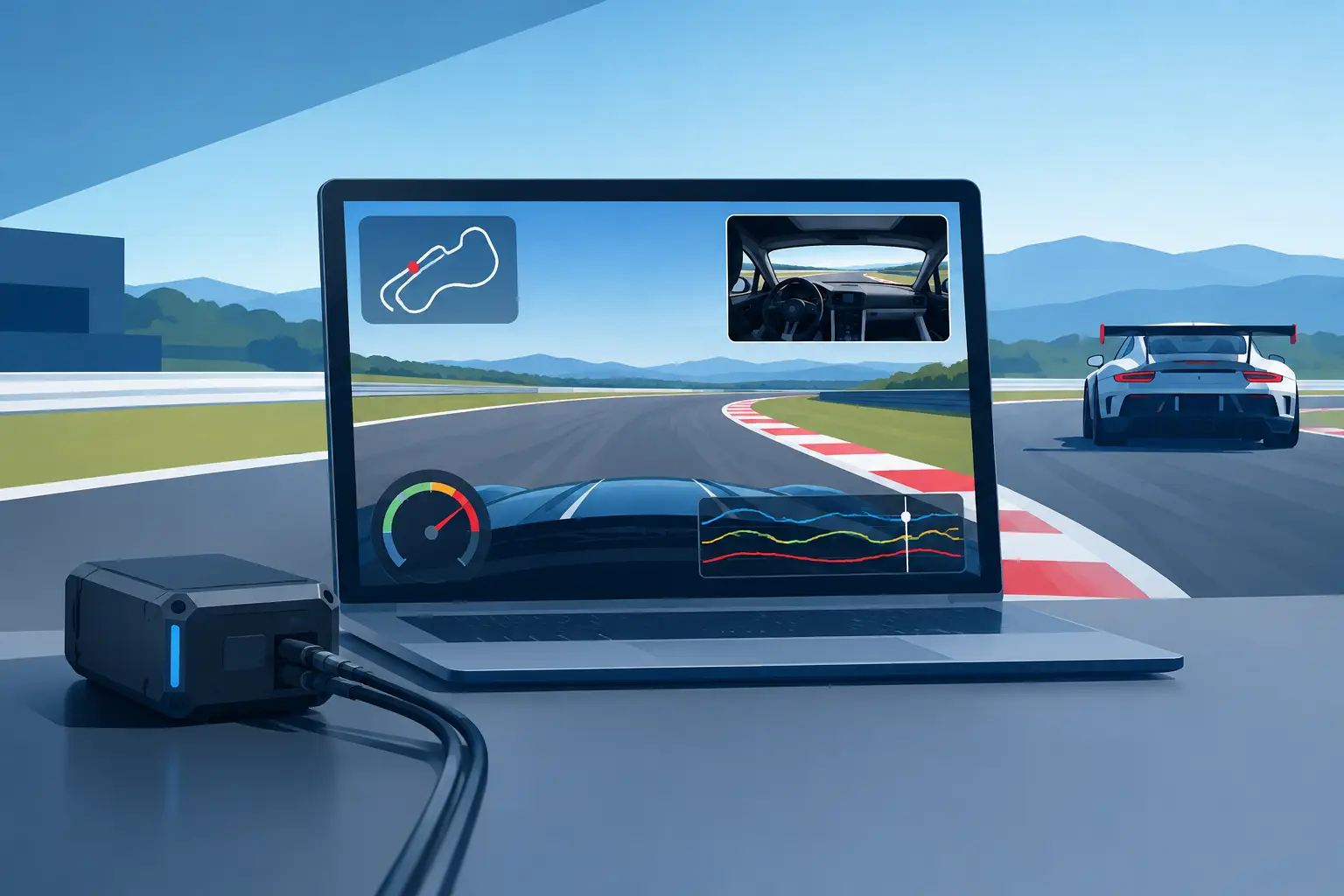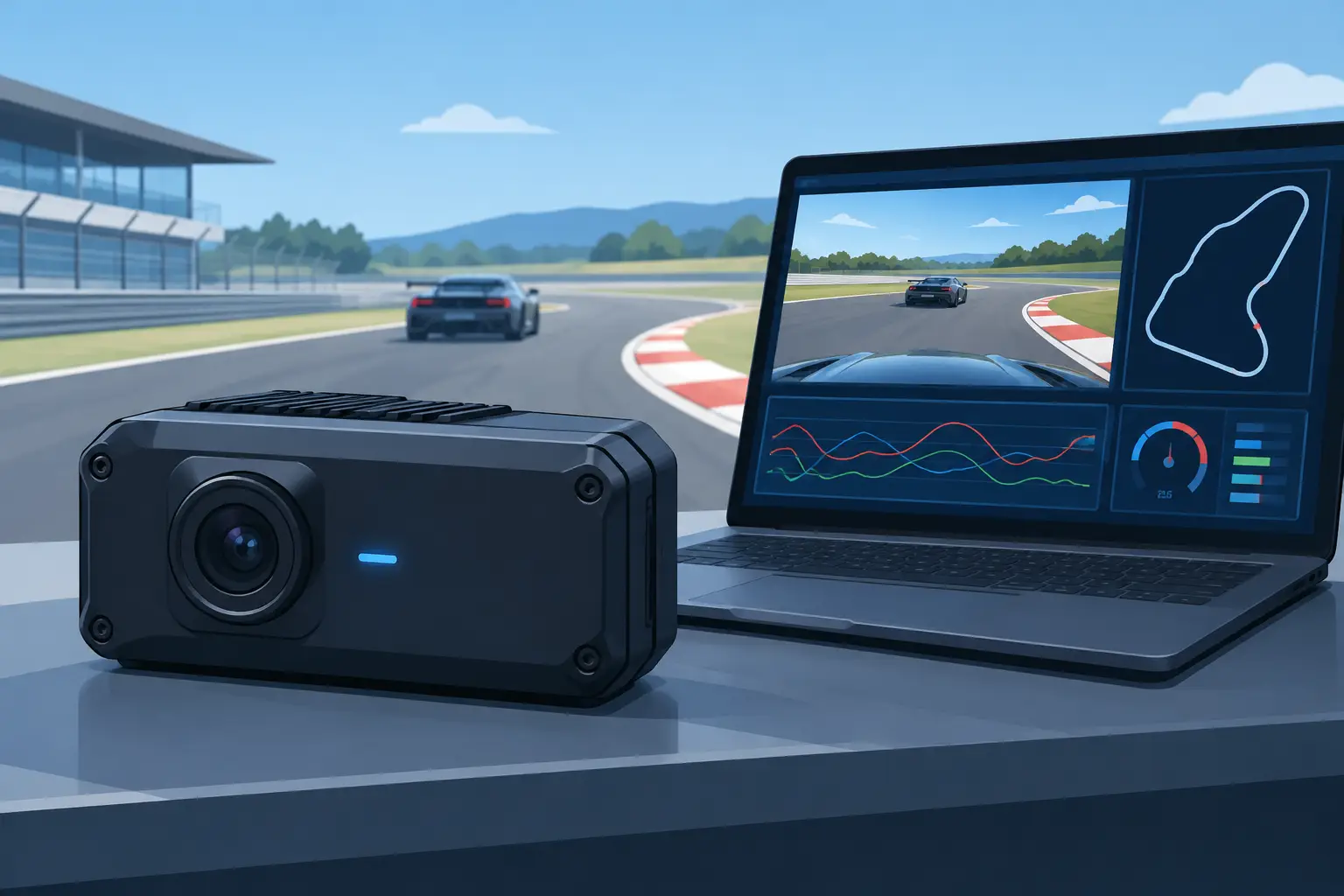
A quick look at an onboard clip rarely tells the whole story. The car may appear settled while minimum speed has fallen, braking begins too early, or throttle application is compromised by a poor exit line. VBOX Video HD2 puts the picture alongside the data that explains it, giving drivers and engineers a practical record of what happened on track rather than a memory formed in the paddock.
For race teams, track-day operators and serious owner-drivers, that distinction matters. A properly installed video and data system can turn a short debrief into a focused discussion about braking markers, apex speed, steering trace, lap position and repeatability. It also creates a useful reference when weather, tyres, setup or driver changes affect the car.
What the VBOX Video HD2 is built to do
The VBOX Video HD2 is an onboard video data-logging system designed around synchronised footage and performance information. It captures the driver’s view through compatible cameras while recording GPS-based positional and speed data. Depending on the vehicle installation and selected inputs, it can also incorporate information from the car, such as engine speed, throttle position, brake pressure, steering angle or other available channels.
The value is not simply the overlay on the finished video. It is the time alignment between the footage and the data. When a driver lifts the throttle, misses an apex or gets wheelspin on exit, the event can be seen at the same point it appears in the trace and on the circuit map. That makes the system useful for post-session analysis, driver tuition and documenting consistent faults that might otherwise be attributed to traffic or tyre condition.
Unlike a consumer action camera, the HD2 is intended to become part of a performance-analysis workflow. Its usefulness comes from accurate installation, reliable recording and a data configuration that matches the questions the team needs answered.
Where VBOX Video HD2 earns its place in a race car
The first application is driver development. A driver can compare a representative lap against a quicker reference and identify where time is lost. Sometimes the answer is obvious: braking is later but less controlled, so the car reaches the apex slowly. In other cases, the video shows the driver using too much kerb, while the data reveals a small but repeated loss of minimum speed. The evidence gives the conversation direction.
It is equally useful when assessing setup changes. If rear damping, tyre pressures, brake balance or aero settings are changed between sessions, the resulting laps can be reviewed with more confidence than stopwatch impressions alone. The aim is not to assume that every change should produce a faster lap immediately. Traffic, track evolution and tyre life can distort a single run. A sequence of comparable laps, supported by video and data, gives a far stronger basis for deciding whether a change is worth retaining.
For endurance and multi-driver teams, the system can also help standardise feedback. Each driver may describe the same corner differently, but the recorded material shows where the car is positioned, how it is being driven and whether the issue occurs consistently. This is particularly helpful when an engineer is balancing driver comments against tyre condition and mechanical checks.
Installation quality affects the data you trust
The HD2 should be treated as a motorsport installation, not an accessory fitted at the last minute. Camera position, GPS antenna placement, power supply, cable routing and any vehicle-data connection all affect day-to-day usability. A poorly mounted camera can shake or point too high. An antenna installed where it has a restricted view of the sky may compromise GPS performance. Loose wiring around a roll cage or dashboard is both untidy and a potential failure point.
Camera placement should give a clear, stable view that allows the driver’s line and reference points to be assessed. In many cars, a forward-facing cockpit position works well, but the right location depends on the screen, roll cage, mirror position and regulations. Avoid positioning that creates excessive reflections, blocks the windscreen view or interferes with the driver’s helmet movement.
Power deserves the same attention. Use an appropriate switched supply, correct fusing and secure connectors. Motorsport vibration, heat and repeated service work quickly expose weak crimping, unsupported cable runs and unsuitable adaptors. Where data is taken from a CAN connection or other vehicle interface, confirm the protocol, connector arrangement and available channels before ordering parts. A logger cannot create meaningful engine or chassis information if the required signal is not present or has been configured incorrectly.
Radios4Racing can support the wider installation requirement with race-ready cabling, connectors and compatible integration components, which is often more useful than trying to make consumer wiring fit a competition car.
Plan the system around the debrief
Before fitting the equipment, decide what the team wants to learn. For basic driver coaching, reliable forward video, circuit position, speed and lap comparison may be enough. For detailed vehicle development, additional channels can be justified, provided they are available and the team has the time to interpret them.
More data is not automatically better. A complex input configuration can add cost, installation time and fault-finding work. If nobody reviews a channel after the event, it is unlikely to earn its place in the car. Start with the information needed to make better decisions, then expand the system when there is a clear use for additional inputs.
Turning a recording into useful performance information
A productive HD2 review starts with comparable laps. Choose runs with similar tyre condition, fuel load and track circumstances where possible. Comparing a clear lap on new tyres with a lap taken in traffic at the end of a stint may be interesting, but it is not a clean test of driver technique or setup.
Look at the lap as a series of linked events rather than isolated corners. An early turn-in may affect how soon the driver can return to throttle. A cautious exit can cost speed for the whole following straight. The footage explains line choice and vehicle attitude, while the GPS and vehicle data show the measurable result. This is where synchronised recording saves time: the driver, engineer and coach are reviewing the same moment, not debating recollections from different parts of the session.
Braking is a good example. A later brake point is only quicker if the driver can maintain control, achieve suitable minimum speed and release the brake in a way that lets the car rotate. Video alone may make a late-braking lap look committed. Data can show whether that commitment actually improved the corner or merely moved the time loss to the exit.
Use the system to identify repeatable patterns, not to chase a single impressive number. If a driver is consistently giving away two tenths in one braking zone, that is a clear target. If the car is unstable over the same bump every lap, the evidence can support a setup discussion or a mechanical inspection. The most useful findings are those that can be tested again in the next session.
Choosing the right level of VBOX Video HD2 setup
The correct specification depends on discipline, vehicle and operating routine. A sprint car used for occasional testing may need a straightforward camera and GPS-based package. A circuit-racing team running multiple cars may require a more integrated configuration, spare leads, protected mounting and a defined process for downloading and reviewing files between sessions.
Rally, hillclimb and track-day use can place different demands on camera mounting, power arrangement and access to vehicle data. The common requirement is dependable recording. If the unit is difficult to operate with gloves on, the leads are vulnerable during routine maintenance, or the memory-handling process is unclear, useful data can be lost at the point it is most needed.
It is worth considering service access as well. Equipment should be mounted securely, but it must remain reachable for inspection, media handling and cable checks. Labeling connections, retaining a simple wiring record and carrying key spares can prevent a small issue becoming a lost session.
A VBOX Video HD2 system pays back when it is used consistently, installed properly and reviewed with a specific question in mind. Fit it as part of the car’s working equipment, then let the evidence from each session guide the next adjustment, briefing or driver change.