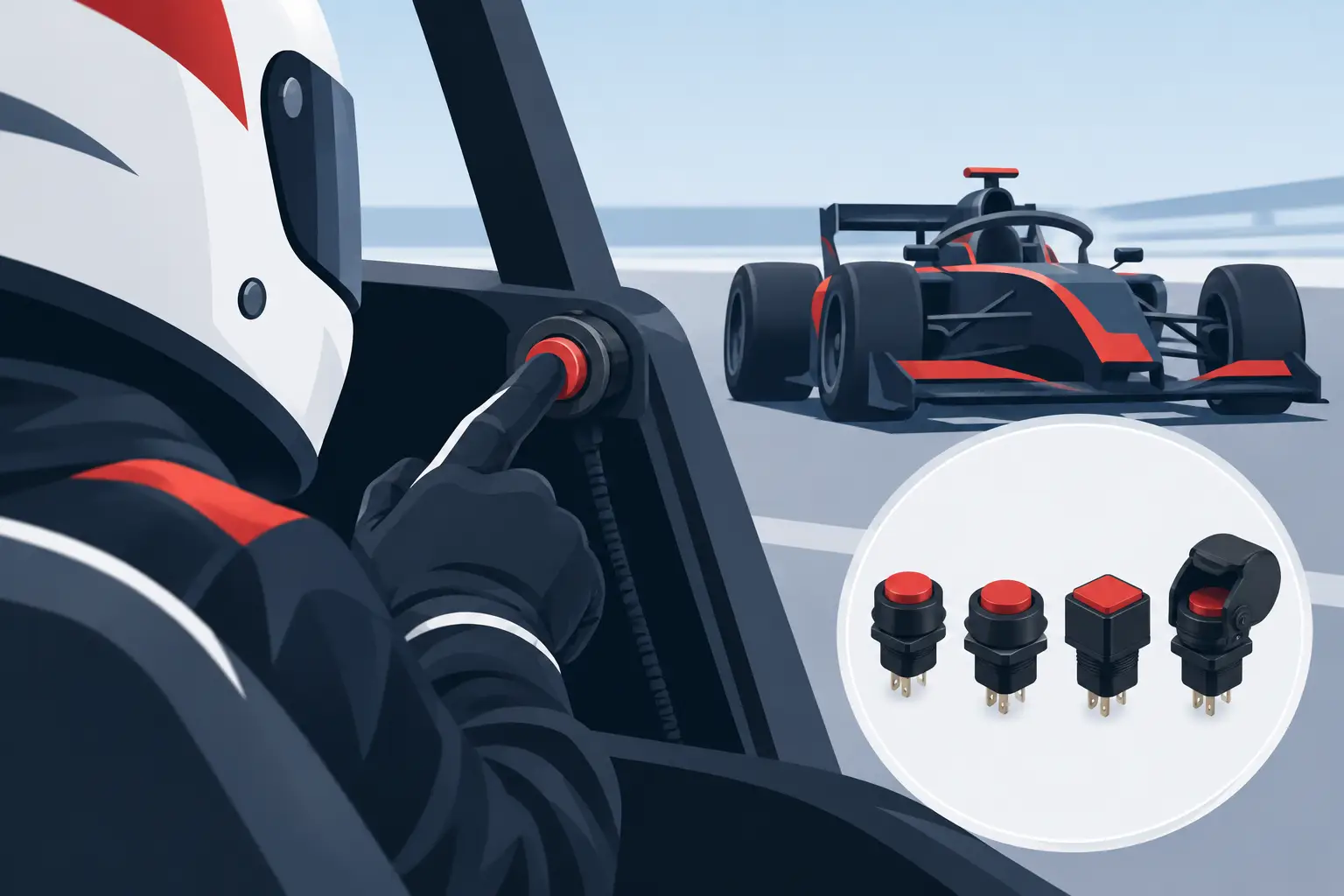
A driver can have a correctly wired radio, a good helmet loom and a capable crew channel, yet still lose the most basic part of the conversation if the transmit control is poorly positioned or unreliable. A small push to talk switch is a modest component in physical size, but it is a critical control point in any race-car communications installation. It must be easy to find with gloved hands, positive enough to operate over kerbs and vibration, and compatible with the radio and intercom system already fitted.
For circuit racing, rallying, endurance events and track-day support vehicles, the right switch is not simply the smallest item that can be attached to the steering wheel. Connector type, cable construction, mounting method and environmental protection all determine whether it remains dependable through a season.
What a small push to talk switch does
A push-to-talk, commonly shortened to PTT, closes the transmit circuit when pressed. This keys the vehicle radio so the driver can speak to the pit wall, service crew or another vehicle on the assigned channel. Releasing the button returns the system to receive mode.
In a race car, the switch normally sits on or close to the steering wheel, though installations vary. A rally crew may require a hand-held or dash-mounted arrangement that both driver and co-driver can reach. A pit-lane vehicle may use a PTT fitted to the gear lever or dashboard. The requirement is the same: deliberate operation without taking attention away from the car.
The switch itself does not improve audio quality. Clear communication still depends on a suitable helmet microphone, speakers or earpieces, correct radio programming and sensible gain settings. What it does provide is a reliable, immediate means of transmitting when the driver needs to report a fault, respond to a pit call or confirm a strategy instruction.
Selecting a small push to talk switch
Start with compatibility, not size. Motorsport communications equipment uses several connector standards and wiring arrangements. LEMO connections are common in professional installations, while other systems may use moulded multi-pin plugs, jack plugs or manufacturer-specific fittings. A PTT that appears similar externally may not be electrically compatible with a Racecom, Speedcom, Autotel, MRTC or Rugged Radios system.
Check the connector at both ends of the intended cable path. Some switches connect directly to a helmet or intercom loom. Others connect to a car harness, extension lead or radio interface. Pin allocation matters as much as the plug style. A wrong configuration can leave the PTT inoperative, create intermittent transmission or affect microphone and speaker operation.
A custom LEMO-based assembly can be the better answer where a car has an existing professional loom, non-standard panel layout or a specific steering-wheel release arrangement. It avoids adding unnecessary adaptors at points that are regularly handled, strained or exposed to vibration.
Button feel and operating force
A good race PTT has a clear action. The driver should be able to tell that the button has been pressed through a glove, without needing excessive force. A button that is too light can be keyed accidentally when manoeuvring the wheel or climbing in and out of the car. One that is too stiff becomes awkward during a long stint, particularly when the driver is managing steering load, switches and paddle shifts.
The ideal operating force depends on placement. A thumb-operated wheel-mounted button benefits from a defined tactile response and a compact body. A larger dash or gear-lever switch can tolerate a firmer action because the driver can use a finger rather than a thumb stretched around the steering rim.
Avoid treating a PTT as a generic momentary switch. Motorsport use brings repeated operation, shock loading, heat and contamination. The switch needs to be intended for the duty cycle and environment involved.
Mounting position in the cockpit
Mounting is a balance between access and protection. On a steering wheel, the switch needs to be within natural thumb reach at normal hand position. It should not interfere with wheel spokes, buttons, paddle-shift movement or a quick-release mechanism. Cable exit direction is equally important: a lead routed across a wheel rim will soon become a snagging risk.
For a fixed-wheel car, a dash-mounted PTT can be a practical option, especially where the driver has limited wheel space. Position it where it can be reached while harnessed in tightly. Test this with the actual seat, helmet, HANS device and gloves in place. A location that seems sensible in the workshop may be inaccessible once the driver is correctly restrained.
Rally installations often need more than one transmit point. A co-driver may need an independent PTT to communicate with service or event control, while retaining the ability to speak internally. This should be designed into the intercom and harness arrangement rather than improvised with loose splitters.
Cable routing is part of the installation
A small push to talk switch can fail because of its cable long before the button mechanism wears out. Steering-wheel installations are particularly exposed. The lead must move with the wheel without being pulled tight at full lock, trapped by the boss, or repeatedly folded in the same place.
Allow adequate service length, but do not leave large unsupported loops. Secure the cable with appropriate clips or ties away from sharp edges, steering columns, pedal boxes and hot ducting. Where the cable passes through a panel, use a grommet or protected bulkhead fitting. A tidy route is not merely cosmetic. It reduces strain, makes fault-finding faster and prevents damage during routine work.
Consider what happens when the steering wheel is removed. If the PTT lead must be disconnected every time, use a suitable connector and give it enough access to be handled without pulling on the cable. If the wheel is regularly changed between drivers, a dedicated wheel loom or properly specified quick-disconnect arrangement is preferable to repeated use of an adaptor.
Sealing and durability in real race conditions
Cockpits are not clean electronic environments. Moisture from wet-weather running, dust from rally stages, cleaning products, fuel vapour and perspiration all find their way into controls and connectors. Open cars and endurance machinery place even greater demands on exposed equipment.
Choose a switch and connector arrangement suited to the level of exposure. A fully enclosed cockpit running short circuit races has different requirements from a rally car that sees rain, dust and frequent service work. Protective boots can help in certain positions, but they must not make the switch vague or difficult to operate with gloves.
Inspect the PTT during pre-event preparation. Check that the button returns cleanly, the cable sheath is not chafed, strain relief is intact and the connector locks positively. Intermittent faults often appear as a radio that transmits only when the wheel is held at a particular angle. That is usually a cable or connector issue, not a radio problem.
Testing before the car reaches the assembly area
A full radio check should include the PTT under realistic conditions. With the driver seated and helmet connected, confirm that pressing the switch keys the radio every time and that releasing it stops transmission. Listen for microphone audio at the crew end and confirm that received audio remains clear in the helmet.
Turn the wheel from lock to lock while testing. Move the quick-release wheel if fitted, gently flex accessible cable sections and check the PTT with race gloves on. This is a simple test, but it finds routing and access problems before the car is queued for qualifying.
For endurance teams, include the PTT in driver-change checks. Different hand sizes, glove thicknesses and wheel positions can expose an installation that worked for the first driver but not the next. Keep a compatible spare switch or wheel loom with the communications kit where practical. A replacement part is of little use if it cannot connect to the installed system.
When repair is preferable to replacement
A faulty PTT does not always mean the entire assembly must be replaced. Damaged cable sections, worn connectors and strained terminations can often be assessed and repaired, particularly where the original loom is integrated into a valuable communications system. Repair is also sensible when retaining a specific connector standard avoids rebuilding a larger part of the car harness.
However, a switch with water ingress, an inconsistent internal contact or repeated failures is not something to tolerate during an event weekend. The cost of a correctly specified replacement is small compared with a missed pit instruction, a delayed response to a mechanical warning or an avoidable safety issue. Radios4Racing can support complete systems, replacement components and compatible bespoke assemblies where an existing installation needs to be retained.
The best small push to talk switch is the one the driver can use without thinking about it. Fit it where the hand naturally falls, protect the cable as carefully as any other race-car wiring, and prove the installation before it is needed in anger.