A missed apex is easy to describe after a session. Proving where it cost time, whether minimum speed fell away, and what changed on the following lap requires properly synchronised evidence. The VBOX Video HD2 Track Package combines on-car video with GPS-derived performance data, giving drivers and engineers a practical record of every lap rather than relying on memory, paddock discussion or a stopwatch alone.
For track-day drivers, it provides clear reference points for repeatable improvement. For race and rally teams, it becomes part of the debrief process: a way to compare driver inputs, corner approach, line choice and sector performance with footage that is aligned to the data.
What the VBOX Video HD2 Track Package is for
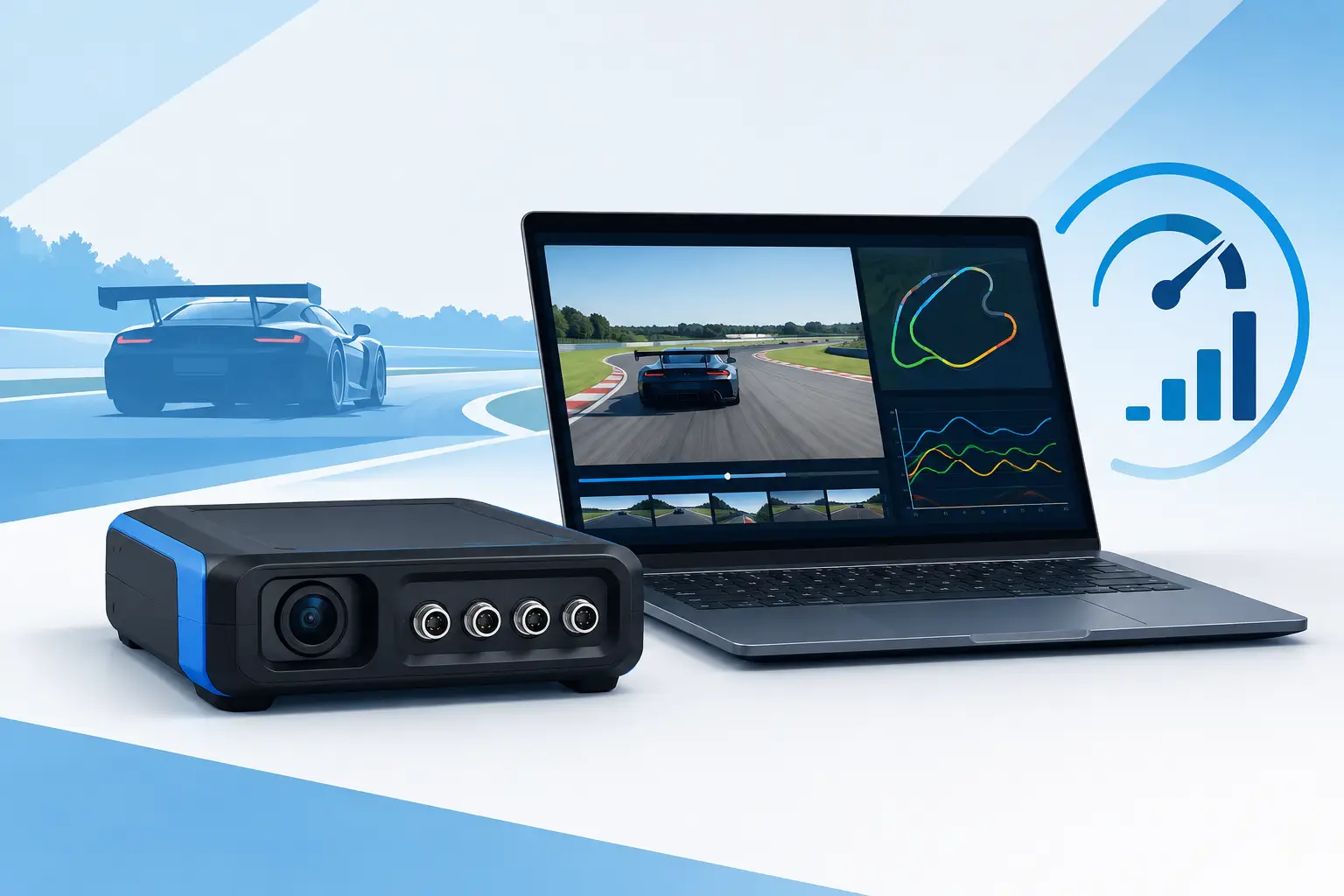
The system is designed for performance analysis in competition and circuit use. It records high-definition video while logging vehicle position and speed data, then overlays selected information onto the footage. The result is not simply an onboard video file. It is a session record that can show where the car was on circuit and how its performance changed through each phase of a lap.
A typical installation uses one or more cameras, a VBOX Video HD2 recorder, GPS aerial, display and vehicle power connection. Package contents can vary by supplied configuration, so the specification should always be checked against the car, intended camera layout and the class or organiser requirements. The important point is that the components are intended to work as one motorsport data-video system rather than as unrelated action cameras and separate timing devices.
The track-focused package suits drivers who want lap timing visible in the car and usable footage after the session. It can support familiar overlays such as lap time, predictive timing, speed, g-force and circuit position, depending on the chosen configuration and data channels. That makes the footage useful in the garage, not just entertaining on social media.
Why synchronised video changes the debrief
Video shows what happened. Data shows when and by how much. Used together, they shorten the distance between an observation and a worthwhile adjustment.
Consider a driver who is three tenths slower through a sector. A basic lap timer identifies the loss, but it cannot show whether the cause was a cautious turn-in, traffic, a late brake release, wheelspin on exit or a compromised line from the preceding corner. With synchronised video and GPS data, the engineer can place the time loss in context. The driver sees the steering, track position and visual references at the same moment the speed trace or delta changes.
This is particularly valuable when chasing consistency. One fast lap can be accidental or affected by traffic gaps, tyre condition or track evolution. Reviewing several laps reveals whether the driver is repeatedly missing the same braking marker, turning in too early, or sacrificing exit speed. The system does not replace driver coaching or engineering judgement, but it gives both a common, objective reference.
There are limits. GPS-based analysis is highly effective for circuit use, yet it will not tell the full story of tyre pressure, brake temperature, damper behaviour or engine condition without additional vehicle data. Where deeper diagnostics are required, teams should specify suitable CAN integration and additional sensors as part of the wider data package. The HD2 is strongest when used for what it does well: relating driver action and vehicle performance to the actual piece of track where it occurred.
Choosing the right installation layout
Camera position matters as much as recorder specification. A forward-facing view provides the clearest picture of braking references, racing line, kerb usage and traffic. A driver-facing camera can add value where hand position, head movement or driver procedure needs reviewing. On some cars, a rearward or external view is useful for launch work, following traffic or evidence after contact, but every added camera should have a purpose.
Mounts must be secure, sight lines should be checked from the driving position, and cable routing must be protected from sharp edges, heat, vibration and moving components. A camera that vibrates, points at the dashboard or loses power during a session creates footage with little engineering value. The same applies to the GPS aerial: it needs a suitable location with a clear view of the sky and an installation that will remain dependable under race conditions.
Power supply is another area where shortcuts cause avoidable faults. Motorsport cars are electrically noisy environments, particularly where ignition systems, alternators, pumps and radios are operating together. Use correct vehicle wiring, sound earth points and appropriate connectors. If the car already carries radio, helmet communication and data-logging equipment, plan the installation as a complete system rather than adding cables wherever space appears available.
This is where compatibility-led supply matters. The recorder, aerial, cameras, display, harnesses, connectors and mounting hardware must all suit the vehicle and each other. A professional installation is easier to service, quicker to inspect between events and less likely to fail because a cable has been strained behind a seat or against a roll cage.
Using VBOX Video HD2 data at the circuit
The best workflow begins before the car leaves the paddock. Confirm that storage media is fitted and has capacity, cameras are clean and correctly aimed, the GPS system has acquired a signal, and the display is operating as expected. It is far easier to correct these items before qualifying than after discovering that the quickest session was not recorded.
During the session, predictive timing can help the driver understand whether a lap is developing positively or negatively relative to a reference. It should be treated as information, not instruction. A driver who stares at a display through every corner is likely to lose more time than the system can help recover. The display should be positioned for a quick, safe glance and used to reinforce known targets rather than distract from driving.
After the run, start with the broad picture. Compare representative laps rather than immediately focusing on the outright quickest one. Look at where time is gained and lost across sectors, then review the corresponding footage at those points. If one driver carries more speed into a bend but loses time on exit, the answer may be a different line or brake release rather than a demand to brake later.
For teams running multiple cars or drivers, agree a consistent reference lap and naming process for recorded sessions. That small amount of organisation prevents confusion when reviewing qualifying, race stints, tyre tests or wet running. It also makes it easier to return to a useful comparison later in the season.
Questions worth asking in the debrief
The useful questions are specific. Was the car positioned correctly for the exit? Did the driver begin braking at the planned marker? Was steering added before the platform was settled? Did a slower entry genuinely produce a faster exit? Was the lap affected by traffic, yellow flags or a change in grip?
Avoid treating a data overlay as a verdict on its own. A lower minimum speed is not automatically wrong if it allows earlier throttle and a stronger run onto the next straight. Equally, the fastest-looking corner entry may be slower over the whole sequence. The value of the VBOX Video HD2 Track Package is that it lets the team test these decisions against the entire section of circuit.
Who should specify the package
The package is a sensible fit for track-day operators, coaching businesses, club racers, professional teams and performance vehicle owners who need more than a basic lap timer. It is especially effective for drivers who already record onboard footage but struggle to turn it into a repeatable development process.
It may be more system than is needed for someone who only wants occasional in-car clips. Conversely, a team with an established ECU logger and a full engineering department may require a wider integration plan. In both cases, the selection should follow the job: number of cameras, display requirements, vehicle-data inputs, mounting positions, storage handling and the level of post-session analysis required.
For a race car that is being developed properly, recording the lap is only the first step. Install the equipment cleanly, verify it before each event, and make the debrief specific enough that the next outing has one or two clear changes to test.