A missed pit instruction is rarely caused by a lack of radio power. More often, it comes down to poor microphone placement, an unsuitable earpiece, a loose connector or a driver helmet communication kit specified without checking the rest of the car system. In a noisy cockpit, every part of the audio chain has to work together.
For circuit racing, rallying and track-day operation, the helmet kit is not an isolated accessory. It is the driver end of a complete communication system linking helmet, car interface, push-to-talk switch, radio, aerial and crew equipment. Selecting it correctly means considering connector type, helmet construction, intended radio system and the serviceability of the installation.
What a driver helmet communication kit needs to do
A driver helmet communication kit must provide intelligible two-way speech under sustained noise, vibration and movement. That sounds straightforward, but race cars create conditions that expose weak equipment quickly. Engine and transmission noise, airflow, vibration through the shell, a balaclava, gloves and a tightly fitted HANS device all affect how the driver hears and speaks.
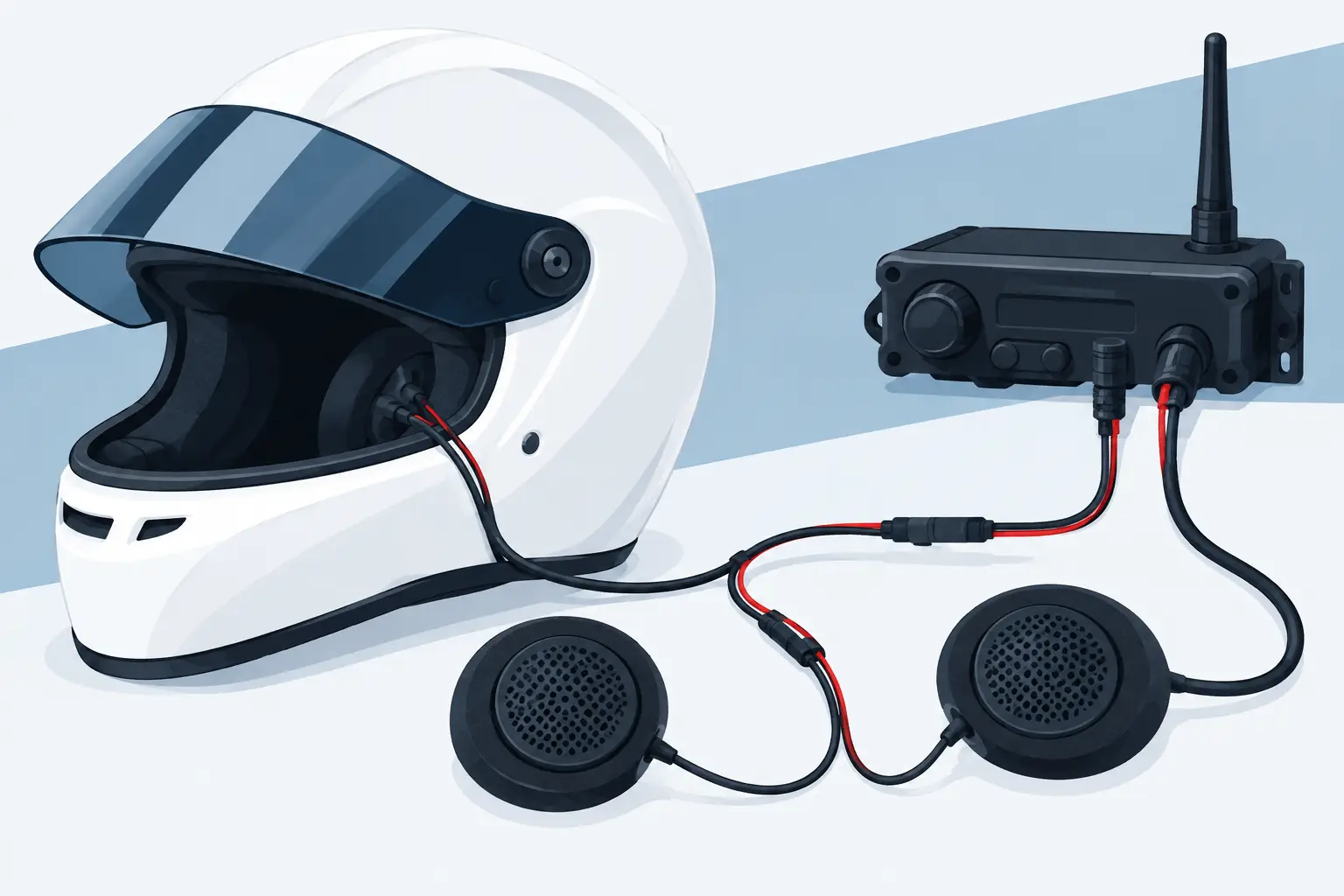
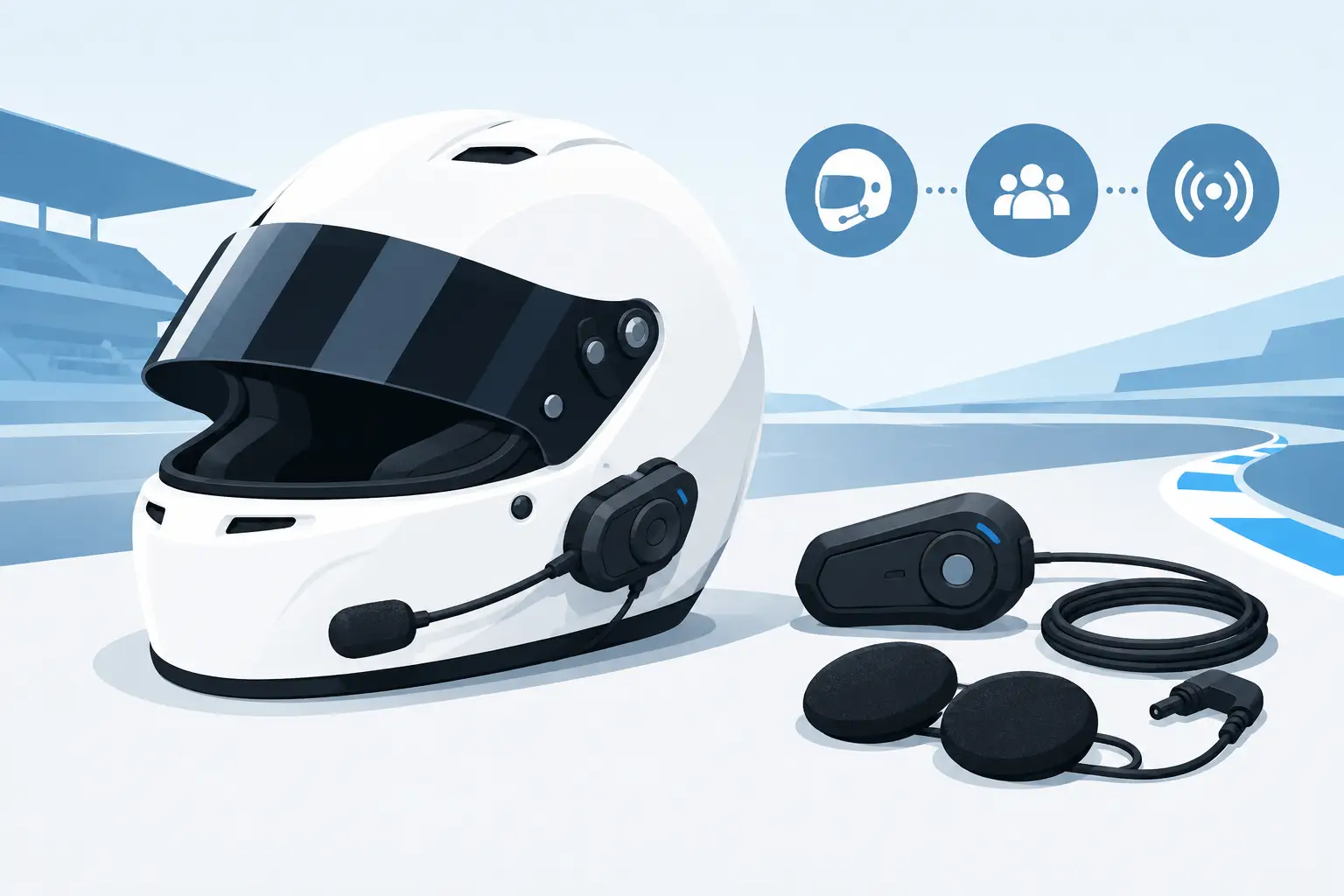
At its core, a typical kit combines a boom microphone, one or two speakers or a moulded earpiece arrangement, internal wiring and an external helmet connector. The external lead then connects to the vehicle loom or radio interface. The exact configuration changes by discipline and helmet, but the priority remains the same: clear speech without the driver having to adjust equipment or raise their voice.
The microphone should sit close enough to the mouth for consistent pickup, without touching the lips or being knocked out of position when the helmet is fitted. A noise-cancelling microphone is especially valuable in open-cockpit cars, rally machinery and cars with high mechanical noise. Speaker positioning matters just as much. If the speakers sit too far from the ears, increasing radio volume may simply make the noise louder rather than the message clearer.
Choose compatibility before features
The first purchasing question is not whether a helmet kit looks similar to an existing one. It is which system it must connect to. Motorsport communication equipment uses several connector formats and pin configurations, including LEMO-based arrangements and brand-specific connections used by Racecom, Speedcom, Autotel, MRTC and Rugged Radios systems. A connector that physically fits is not necessarily wired correctly.
Confirm the radio or car interface already installed, the helmet-side connector required, the number of poles, the pinout and whether the microphone and speaker wiring are compatible. This is particularly relevant when replacing only the helmet assembly on an older installation. Teams frequently retain proven radios and car looms, then find that an otherwise suitable replacement kit has a different wiring standard.
A compatible adaptor can be a practical answer where a fleet contains mixed equipment, but it should not be treated as a cure for every mismatch. Each additional connection is another point that can loosen, corrode or be damaged during a hurried driver change. Where possible, specify the correct helmet lead and car interface from the outset.
Matching the helmet type
The helmet itself determines how the installation should be approached. A closed-face circuit helmet generally allows a protected boom position and tidy speaker routing beneath the lining. Open-face rally helmets may need a more exposed microphone arrangement and benefit from components designed to resist wind noise. Some helmets have dedicated recesses for speakers; others require careful positioning behind the cheek pads or liner.
Do not assume that a universal kit will suit every shell. Before fitting, inspect the liner, speaker pockets, cable paths and the point where the external connector will sit. The wiring must not create a pressure point, interfere with helmet retention or compromise the liner. Work should be carried out carefully, with the helmet manufacturer’s guidance taken into account where applicable.
A detachable external lead is useful for routine storage and transport, while a panel-mounted connector can offer a more secure long-term solution. The trade-off is installation complexity. A permanent, neatly mounted connector suits a race helmet used with one established system. A more flexible arrangement may suit a driver moving between cars, events or disciplines.
Build the kit around the complete car system
A helmet kit can only perform as well as the equipment around it. The usual signal path is simple: helmet kit to car harness, car harness to push-to-talk or radio interface, then radio to aerial. In practice, failures occur at each of those junctions.
The car harness must be long enough for normal driver movement without leaving excess cable to snag around the seat, belts or steering column. Route the lead so it does not pull when the driver turns their head, reaches for controls or exits the car. A lead that is just long enough in the workshop may become tight once the driver is fully belted in and wearing a HANS device.
Push-to-talk placement deserves the same attention. A button that cannot be operated with gloves, or one mounted where steering input activates it accidentally, creates its own problems. Steering-wheel, gear-lever and dash-mounted options each have a place depending on the cockpit layout. Test the chosen position with the driver strapped in, not with the car stationary and unoccupied.
Radio aerial location and earth quality also affect perceived audio quality. If transmitted speech is weak, distorted or intermittent, replacing the helmet kit may not resolve the fault. Check the aerial, cable, connectors, power supply, radio settings and vehicle interface before condemning the helmet hardware.
Audio quality is about fit, not maximum volume
Drivers sometimes request more volume when they cannot hear the pit wall. That can help, but it is not always the correct fix. Excessive volume can become fatiguing over a long stint and may mask rather than solve poor speech clarity. Correct speaker alignment, microphone placement and noise reduction usually provide better results.
For sprint racing, a well-positioned two-speaker arrangement may be entirely suitable. For endurance racing, where drivers spend longer in the car and pit-to-driver exchanges are more frequent, comfort becomes a larger factor. Earpieces or custom-moulded solutions can improve isolation and consistency, but they need to be selected with care. The driver must be comfortable wearing them for the full session, and the system still needs to remain practical for rapid driver changes.
Test communications with the engine running, preferably in the actual paddock or pit-lane environment. A bench test confirms continuity. It does not reproduce vibration, alternator noise, airflow or the driver’s speaking position under load. Ask the driver to speak normally, then at race effort, and check that crew can understand both.
Installation and maintenance checks
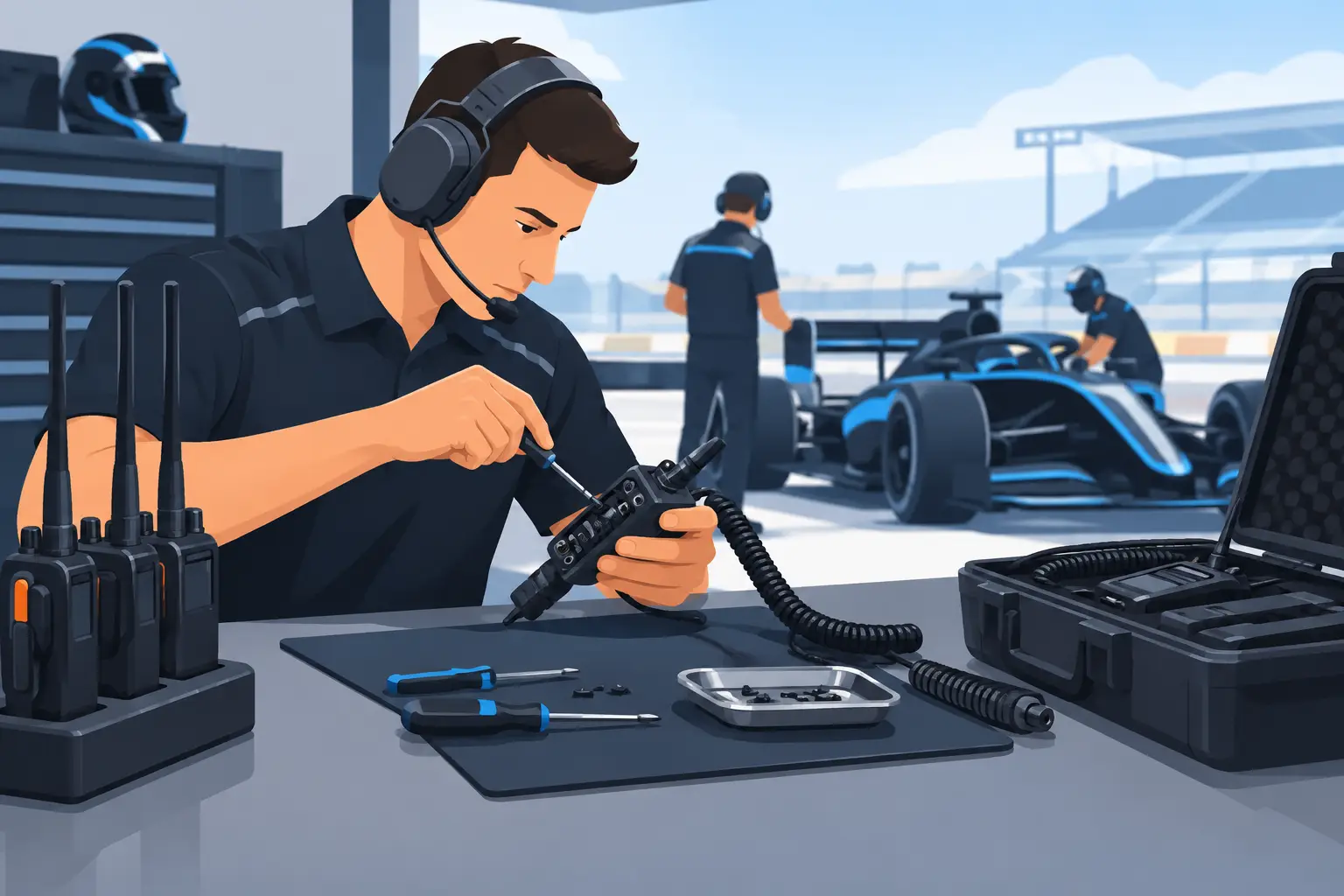
A professional installation should be treated as part of race preparation, not a one-off fitting job. Before each event, inspect the boom, speaker wires, helmet connector, vehicle lead and push-to-talk switch. Look for crushed cable insulation, pulled strain reliefs, bent pins and connectors that no longer lock positively.
The following checks are worth including in the pre-event electrical routine:
- confirm transmit and receive audio with the driver wearing the helmet;
- check that the push-to-talk switch operates reliably with gloves on;
- inspect leads where they pass the seat, door aperture and harness belts;
- clean and dry connectors before packing equipment away;
- carry a known-good lead or adaptor where the event programme makes communication critical.
Do not pull connectors apart by the cable. Grip the connector body, release any locking mechanism and keep dust caps fitted when equipment is not in use. Moisture and dirt inside a connector can create intermittent faults that are difficult to diagnose between sessions.
When a system begins to crackle, cut out or lose one side of the audio, resist the temptation to replace every component at once. Isolate the fault methodically. Try a known-good helmet on the same car loom, then the suspect helmet on another compatible setup. This establishes whether the issue sits in the helmet kit, vehicle wiring, radio or aerial system.
Specify for repair as well as purchase
Race communications equipment is expensive because it is designed for a hard working environment, not because it is disposable. A kit with replaceable microphones, speakers, connectors and leads can be a better long-term choice than a sealed assembly that must be discarded after minor damage. This matters for teams operating several cars and for owner-drivers who need equipment to remain compatible over multiple seasons.
Radios4Racing supports complete systems, replacement components and equipment servicing for established motorsport communications brands. That makes it possible to match a driver helmet communication kit to the radio system already in the car, rather than rebuilding a working installation around an incompatible part.
The right kit should disappear into the driver’s routine: fitted correctly, connected positively and heard clearly when the call comes. That is the standard worth specifying before the car reaches the assembly area.